Introduction
Artificial intelligence is changing software development at an unprecedented pace. AI coding tools have evolved from simple autocomplete systems into sophisticated development assistants that can generate code, explain complex projects, identify errors, create tests, and support complete software workflows.
The next stage of this evolution is already focused on AI coding agents, automation, intelligent code generation, and autonomous development workflows.
Instead of using AI only to generate individual lines of code, developers can increasingly use AI systems to understand project requirements, analyze repositories, modify files, run tests, and assist with debugging.
This transformation could change how developers build software and how businesses manage development teams.
However, the future of AI coding is not simply about replacing programmers. Human developers will continue to play important roles in architecture, security, product strategy, quality control, and technical decision-making.
This guide explores the future of AI coding tools, including AI agents, automation, natural-language programming, intelligent testing, cybersecurity, developer productivity, challenges, and the technologies likely to shape next-generation software development.
What Are AI Coding Tools?
AI coding tools are software applications that use artificial intelligence to assist with programming and software engineering.
They can help developers:
- Generate code
- Complete code
- Explain programming logic
- Debug errors
- Refactor applications
- Create tests
- Write documentation
- Analyze repositories
- Build software components
- Automate repetitive tasks
Some tools work inside traditional code editors, while others provide dedicated AI development environments.
Modern systems are becoming increasingly context-aware, allowing AI to understand more than just the line of code currently being edited.
How AI Coding Tools Are Evolving
Early AI coding assistants primarily focused on autocomplete.
A developer would start writing a function, and the AI would suggest the next few lines.
Modern systems can do much more.
They can potentially understand:
- Entire files
- Multiple files
- Project structures
- Dependencies
- Documentation
- Error messages
- Development instructions
- Testing requirements
The development workflow is therefore moving from code completion toward software engineering assistance.
The next major step is greater agentic automation.
The Rise of AI Coding Agents
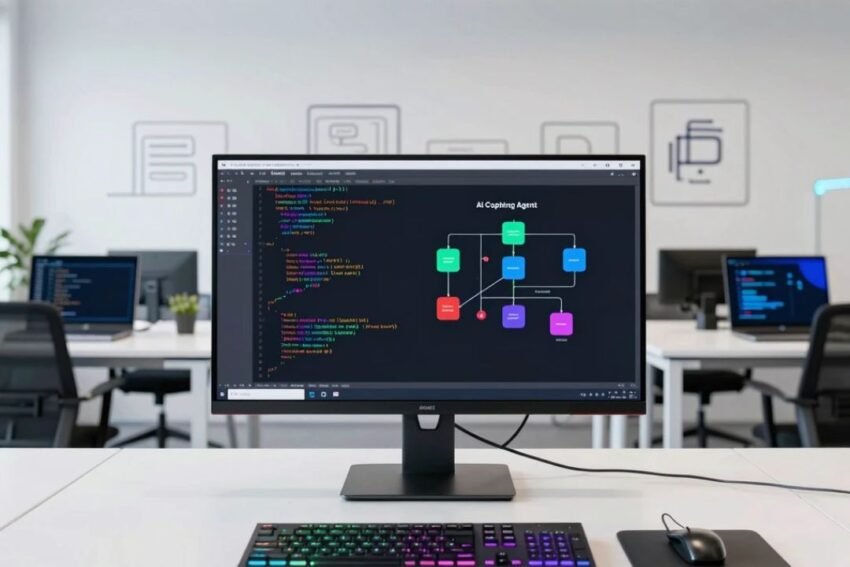
AI coding agents are one of the most important developments in the future of software development.
A traditional coding assistant generally waits for a developer’s prompt and returns a suggestion.
An AI coding agent can potentially perform multiple steps toward a larger goal.
For example, a developer could request:
Build a user authentication system and add automated tests.
An AI coding agent may potentially:
- Inspect the project.
- Identify relevant files.
- Understand the existing architecture.
- Create an implementation plan.
- Modify source code.
- Add configuration.
- Generate tests.
- Run the tests.
- Analyze failures.
- Suggest additional changes.
The exact capabilities depend on the specific AI system and the permissions provided to it.
AI-Powered Software Automation
Automation will likely become one of the biggest advantages of AI coding systems.
Traditional automation generally follows predefined rules.
AI-powered automation can potentially handle tasks that require interpretation.
For example, an AI development system could analyze a bug report and determine which part of the application may need modification.
AI automation could support:
- Code generation
- Testing
- Documentation
- Debugging
- Code review
- Deployment preparation
- Dependency updates
- Project analysis
- Software migration
This can reduce repetitive developer workloads.
Natural-Language Programming
One major future trend is natural-language programming.
Instead of expressing every requirement using programming syntax, developers can increasingly describe desired behavior in everyday language.
For example:
Create a dashboard that displays monthly sales, customer growth, and product performance.
An AI coding system could potentially create the initial application structure.
The developer would then review and customize the implementation.
Natural-language programming does not mean traditional programming languages will disappear.
Instead, natural language may become another interface for interacting with software development systems.
AI and Code Generation
Code generation will continue becoming more sophisticated.
Future AI systems may generate larger software components rather than individual functions.
Potential examples include:
- Complete web pages
- API services
- Database schemas
- Authentication systems
- Backend modules
- Mobile components
- Testing frameworks
- Configuration files
Developers may increasingly describe the required behavior and let AI produce an initial implementation.
Human review will remain necessary for complex and critical systems.
AI-Powered Debugging
Debugging is one area where AI can potentially provide significant assistance.
Future AI coding tools may become better at understanding the relationship between:
- Source code
- Logs
- Error messages
- Runtime behavior
- Dependencies
- Recent changes
- Test results
Instead of simply suggesting a possible fix, advanced AI agents may potentially reproduce a problem, analyze the relevant code, test different solutions, and report the results.
This could reduce the time required to investigate certain software problems.
However, developers will still need to verify whether the AI’s diagnosis is correct.
AI-Powered Software Testing
Testing is likely to become increasingly automated.
AI systems can already assist with generating test cases, and future tools may become more capable of identifying missing scenarios.
Potential capabilities include:
- Unit-test generation
- Integration testing
- Regression testing
- Edge-case discovery
- Test-data generation
- Automated test analysis
- Failure investigation
AI could potentially analyze application behavior and recommend additional tests.
This may help development teams identify problems earlier in the software lifecycle.
AI Code Review
Code review is another area that could benefit from AI.
An AI coding system can potentially inspect code and identify:
- Bugs
- Security weaknesses
- Duplicate logic
- Poor naming
- Performance concerns
- Style inconsistencies
- Potential maintenance problems
AI-generated reviews can provide another layer of assistance before human developers review a change.
However, AI should complement rather than completely replace human code reviews.
Experienced engineers can understand business requirements and architectural decisions that automated systems may not fully understand.
AI and Software Security
Security will become increasingly important as AI coding tools gain more autonomy.
AI-generated code must be evaluated for common vulnerabilities such as:
- Injection attacks
- Authentication problems
- Authorization errors
- Hardcoded credentials
- Unsafe dependencies
- Insecure API usage
- Poor input validation
- Improper data handling
Future AI coding tools may include more security-aware development features.
They could potentially identify security weaknesses while code is being generated.
Security checks may become integrated directly into AI-assisted development workflows.
AI Agents and DevOps
AI coding agents may also become more connected to DevOps processes.
Potential applications include:
- Build troubleshooting
- Test automation
- Deployment preparation
- Infrastructure configuration
- Monitoring analysis
- Incident investigation
- Dependency management
For example, an AI system could potentially analyze a failed build, identify the cause, suggest a fix, and prepare a change for developer approval.
This could make software development and operations more closely integrated.
AI and Cloud Development
Cloud computing is another important area for AI-assisted programming.
Modern applications often involve:
- Cloud databases
- Containers
- Serverless functions
- APIs
- Virtual machines
- Storage systems
- Identity management
- Monitoring
AI coding tools can potentially help developers create and configure cloud applications.
However, cloud infrastructure can involve significant security and financial risks.
AI-generated infrastructure configurations should therefore be reviewed before deployment.
AI for Legacy Software
Many organizations depend on older software systems.
Legacy applications can be difficult to maintain because documentation may be incomplete and original developers may no longer be available.
AI coding systems could help analyze legacy code and explain how different components work.
Potential applications include:
- Code documentation
- Language migration
- Refactoring
- Dependency analysis
- Test generation
- Modernization planning
For example, AI could assist with migrating older software to a newer programming language or framework.
Human engineers would still need to verify the migration carefully.
AI and Software Architecture
AI coding tools are becoming increasingly capable of discussing architecture.
Developers can ask AI systems to compare different approaches for:
- Databases
- APIs
- Authentication
- Microservices
- Cloud systems
- Application frameworks
Future AI systems may provide more advanced architecture assistance by analyzing project requirements and suggesting possible designs.
However, architecture decisions often involve business priorities, operational constraints, security requirements, and long-term maintenance.
Human engineering judgment will remain important.
AI-Powered Documentation
Documentation is frequently neglected because developers are focused on building software.
AI can automate parts of the documentation process.
Potential applications include:
- API documentation
- Function descriptions
- README files
- Architecture summaries
- Release notes
- Setup instructions
- Code comments
Future AI systems could potentially keep documentation synchronized with software changes.
This could make software projects easier to understand and maintain.
AI and Developer Productivity
One of the biggest impacts of AI coding tools may be increased developer productivity.
AI can reduce time spent on repetitive activities.
Developers may spend more time on:
- Product design
- Architecture
- Security
- User experience
- Testing strategy
- Complex problem-solving
Instead of measuring productivity only by the number of lines of code written, organizations may increasingly focus on outcomes such as software quality, development speed, reliability, and customer value.
AI Coding Tools for Beginners
AI coding assistants can make programming more accessible.
Beginners can use AI to:
- Learn syntax
- Understand errors
- Explore programming concepts
- Create simple projects
- Generate practice exercises
- Receive explanations
- Improve code
However, beginners should not depend entirely on AI-generated solutions.
Understanding fundamental concepts remains important because developers need to recognize whether generated code is correct.
AI Coding Tools for Professional Developers
Professional developers may use AI for increasingly advanced workflows.
Potential applications include:
- Large codebase analysis
- Automated refactoring
- Test generation
- Debugging
- Feature development
- Code review
- Documentation
- Migration
- DevOps assistance
The developer’s role may increasingly shift toward supervising AI-assisted workflows and validating results.
This does not reduce the importance of technical knowledge.
Instead, developers may need broader skills in architecture, security, systems thinking, and AI-assisted development.
Multi-Agent Software Development
A future development environment could involve multiple specialized AI agents.
For example:
Coding Agent
Writes and modifies software.
Testing Agent
Creates and runs tests.
Security Agent
Searches for vulnerabilities.
Documentation Agent
Maintains technical documentation.
DevOps Agent
Assists with deployment and infrastructure.
Review Agent
Examines proposed changes.
These systems could potentially collaborate on a development task.
Human developers could supervise the overall workflow and approve important decisions.
AI Coding and Team Collaboration
AI may also change how development teams collaborate.
Instead of each developer manually handling every routine task, teams could use AI assistants for:
- Meeting summaries
- Technical documentation
- Codebase explanations
- Task preparation
- Code reviews
- Testing
- Project updates
AI could help reduce information gaps between developers working on different parts of a project.
However, organizations will need clear policies for AI usage, data access, and responsibility.
Privacy and Data Security
As AI coding tools become more integrated into development environments, privacy will become increasingly important.
Developers may provide AI systems with access to:
- Source code
- Documentation
- Configuration files
- Internal APIs
- Project information
Organizations should understand how this information is processed.
Important considerations include:
- Data retention
- Access controls
- Encryption
- Enterprise privacy settings
- Source-code protection
- User permissions
Sensitive credentials and confidential information should be protected from unnecessary exposure.
Challenges of the Future of AI Coding
Despite rapid progress, several challenges remain.
Reliability
AI systems can still make mistakes.
Security
Greater AI autonomy can increase the consequences of incorrect actions.
Privacy
AI tools may interact with sensitive development information.
Cost
Advanced AI development systems may involve subscription or usage-based costs.
Over-Automation
Too much automation can make mistakes more difficult to detect.
Skill Development
Developers need to maintain strong programming and engineering fundamentals.
Human Oversight
Critical software systems require appropriate human review.
The Changing Role of Developers
AI is likely to change the role of software developers rather than simply eliminate it.
Developers may increasingly become:
- System designers
- AI supervisors
- Security reviewers
- Architecture specialists
- Product-focused engineers
- Quality controllers
Programming fundamentals will remain important.
Developers will need to understand what the AI is producing and determine whether the result meets technical and business requirements.
Skills Developers Should Learn
Developers preparing for the future should consider learning:
- Programming fundamentals
- Data structures and algorithms
- Software architecture
- Cybersecurity
- Cloud computing
- Databases
- APIs
- Testing
- DevOps
- AI-assisted development
Learning how to communicate clearly with AI systems may also become an important professional skill.
Best Practices for AI-Assisted Development
Developers can prepare for the future by following responsible practices.
Review AI-Generated Code
Important code should receive human review.
Test Everything
Automated and manual testing remain essential.
Protect Sensitive Information
Avoid exposing confidential source code or credentials unnecessarily.
Use Version Control
Maintain clear histories of AI-assisted changes.
Limit AI Permissions
Give AI agents only the access required for their tasks.
Monitor Automated Workflows
Agentic systems should be monitored when they perform actions automatically.
Maintain Human Approval
Critical deployments and security-sensitive changes should require appropriate approval.
The Future of Software Development
The future of software development is likely to combine humans, AI assistants, and automated agents.
A developer may describe a product requirement in natural language.
AI systems could potentially:
- Design an initial architecture
- Generate application code
- Create database structures
- Write tests
- Analyze security
- Prepare documentation
- Assist with deployment
The developer could then review the entire workflow and make important technical decisions.
This could make software development faster while shifting human effort toward higher-level engineering.
AI Coding Tools and the Next Generation of Programming
The next generation of programming may involve less manual boilerplate and more intelligent collaboration.
Developers may increasingly communicate with AI using natural language, code, diagrams, specifications, and structured requirements.
AI systems may become better at understanding context and maintaining consistency across entire projects.
This could make software creation accessible to a broader range of people while still requiring experienced engineers for complex systems.
The fundamental principles of software engineering will remain important even as development interfaces change.
Conclusion
The future of AI coding tools is moving toward greater automation, intelligent assistance, and agentic software development.
AI coding assistants can already help developers generate code, debug problems, create tests, explain software, and write documentation. The next stage involves AI coding agents that can potentially understand project requirements, work across multiple files, run tests, investigate problems, and coordinate longer development workflows.
Natural-language programming, AI-powered code review, automated testing, security analysis, cloud development, DevOps automation, and legacy-system modernization are likely to become increasingly important areas of AI-assisted software engineering.
However, the future will not depend on AI alone.
Human developers will continue to provide architecture, creativity, technical judgment, security oversight, and product understanding. As AI becomes more capable, developers may spend less time writing repetitive code and more time designing reliable systems and evaluating automated results.
Businesses should also approach AI coding adoption carefully by considering privacy, security, permissions, cost, testing, and human oversight.
AI coding tools could become one of the most important technologies in the future of software development.
The developers who learn to combine strong programming fundamentals with AI-assisted workflows will be better prepared for a development environment where intelligent tools and human expertise work together.