Introduction
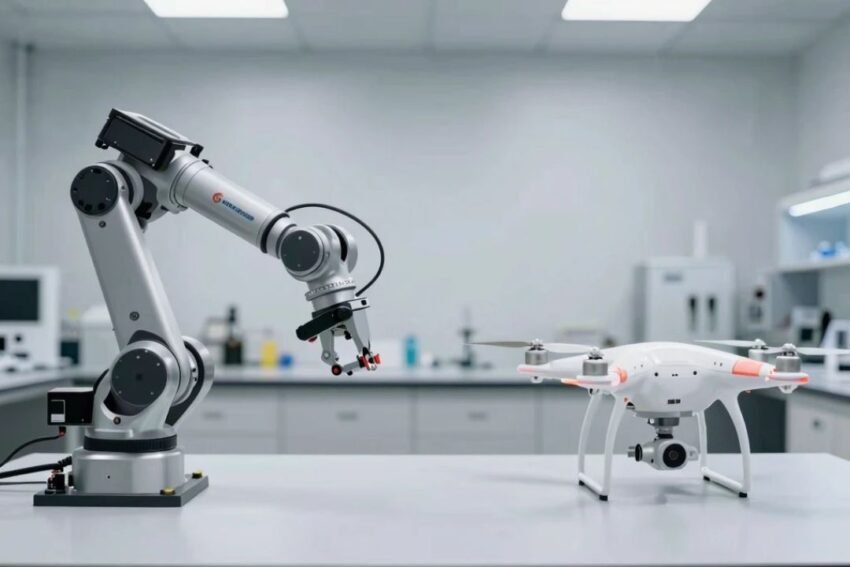
Robotics vs drones is an interesting technology comparison because both fields are transforming automation, business operations, manufacturing, agriculture, logistics, inspection, healthcare, and everyday life. Robots and drones can both use artificial intelligence, sensors, cameras, processors, navigation systems, and advanced software, but they are designed for different environments and tasks.
Robotics generally focuses on machines that can perform physical tasks, often on the ground or inside controlled environments. Drones are unmanned aircraft designed to fly and perform tasks from the air. Some drones can operate autonomously, making them a specialized form of robotic technology.
Businesses are increasingly adopting robots and drones to automate repetitive tasks, collect data, improve efficiency, reduce risks, and access difficult environments. However, each technology has different strengths, limitations, costs, and applications.
Understanding the difference between robotics and drones can help businesses, developers, students, and technology enthusiasts determine which solution is appropriate for a particular task.
What Is Robotics?
Robotics is the field of technology concerned with designing, building, programming, and operating machines that can perform physical tasks.
Robots can be simple machines that perform repetitive movements or advanced AI-powered systems capable of navigating complex environments.
A robotic system can include:
- Sensors
- Cameras
- Motors
- Actuators
- Processors
- Software
- Artificial intelligence
- Communication systems
Robots are used in manufacturing, warehouses, healthcare, agriculture, homes, research, and many other industries.
What Are Drones?
Drones are unmanned aircraft systems that can be controlled remotely or operate autonomously.
Drones typically include:
- Propellers
- Motors
- Flight controllers
- GPS
- Cameras
- Sensors
- Batteries
- Wireless communication
- Navigation software
Drones can fly through environments that would be difficult for ground-based robots to reach.
They are commonly used for photography, mapping, surveying, agriculture, inspections, monitoring, emergency response, and other applications.
Robotics vs Drones: Key Difference
The main difference between robotics and drones is the environment in which they operate.
Robotics is a broad field that includes machines operating on land, inside factories, underwater, and in other environments.
Drones are specifically designed as unmanned aircraft and therefore primarily operate in the air.
In simple terms:
Robotics = broad field of physical automation
Drones = unmanned aerial technology
Drones can therefore be considered part of the broader robotics and autonomous systems ecosystem in some contexts.
Robotics vs Drones Comparison
| Feature | Robotics | Drones |
|---|---|---|
| Primary environment | Ground, factories, homes, specialized environments | Air |
| Movement | Wheels, tracks, legs, arms | Propellers or other flight systems |
| Main purpose | Physical automation and manipulation | Aerial movement, monitoring and data collection |
| Common sensors | Cameras, LiDAR, force sensors, proximity sensors | Cameras, GPS, LiDAR, obstacle sensors |
| AI applications | Navigation, object recognition, automation | Navigation, object detection, image analysis |
| Battery importance | Depends on robot type | Extremely important for flight time |
| Common industries | Manufacturing, healthcare, logistics | Agriculture, mapping, inspection, photography |
| Human control | Can be autonomous or supervised | Can be remotely controlled or autonomous |
Types of Robotics
Robotics includes many different categories.
Industrial Robots
Industrial robots are commonly used in manufacturing.
They can perform:
- Welding
- Painting
- Assembly
- Packaging
- Material handling
These machines are designed for accuracy and repetitive production tasks.
Collaborative Robots
Collaborative robots, or cobots, are designed to work near human employees.
They can assist with:
- Assembly
- Inspection
- Packaging
- Machine operation
Autonomous Mobile Robots
AMRs can move independently through environments such as warehouses.
They can transport products, equipment, and materials between locations.
Humanoid Robots
Humanoid robots have human-inspired structures and may include arms, legs, cameras, and advanced AI systems.
They are being explored for industrial, research, service, and educational applications.
Service Robots
Service robots can assist people with cleaning, hospitality, healthcare support, and other activities.
Types of Drones
Drones also come in different forms.
Camera Drones
Camera drones are widely used for photography and video production.
Agricultural Drones
Agricultural drones can collect aerial data for crop monitoring and field analysis.
Mapping Drones
Mapping drones capture aerial imagery to support surveying and geographic analysis.
Inspection Drones
Inspection drones can examine infrastructure such as bridges, towers, solar installations, and industrial facilities.
Delivery Drones
Delivery drones are being developed for transporting small packages and other items.
How Robotics Technology Works
Robots use a combination of hardware and software.
Sensors
Sensors provide information about the environment.
Examples include cameras, LiDAR, ultrasonic sensors, motion sensors, and force sensors.
Processors
Processors analyze information and execute software instructions.
Actuators
Actuators allow robots to move their wheels, arms, joints, and other components.
Artificial Intelligence
AI can help robots recognize objects, navigate spaces, and adapt to changing conditions.
Software
Software determines how a robot responds to information and performs tasks.
How Drone Technology Works
Drones use several systems to remain stable and navigate through the air.
Flight Controller
The flight controller manages the drone’s movement and stability.
Motors and Propellers
Motors and propellers generate the force required for flight.
GPS and Navigation
GPS can help drones determine their location and follow planned routes.
Sensors
Sensors can detect obstacles, movement, altitude, and environmental conditions.
Cameras
Cameras allow drones to collect visual information.
Battery
Battery capacity directly affects flight time, range, and payload capability.
Robotics Applications
Robotics has a wide range of applications.
Manufacturing
Robots can automate assembly, welding, painting, packaging, and inspection.
Warehousing
Robots can move products and assist with inventory operations.
Healthcare
Medical robotics can support surgical procedures, rehabilitation, laboratory automation, and hospital logistics.
Agriculture
Robots can assist with crop monitoring, harvesting, and other agricultural tasks.
Homes
Consumer robots can perform cleaning and lawn-maintenance tasks.
Research
Robots can operate in environments that are difficult for humans to access.
Drone Applications
Drones are particularly useful for tasks that benefit from aerial access.
Agriculture
Drones can monitor crops and collect field data.
Photography
Camera drones provide aerial perspectives for films, real estate, travel, and marketing.
Construction
Drones can survey construction sites and document project progress.
Infrastructure Inspection
Drones can inspect towers, bridges, pipelines, solar panels, and other structures.
Search and Rescue
Drones can quickly survey large areas during emergency operations.
Mapping
Drones can collect aerial data for maps and three-dimensional models.
Benefits of Robotics
Robotics can provide several advantages.
Productivity
Robots can perform repetitive operations efficiently.
Precision
Automated systems can perform movements consistently.
Safety
Robots can handle some dangerous or physically demanding tasks.
Continuous Operation
Some robots can operate for long periods with limited breaks.
Automation
Robotics can reduce repetitive manual workloads.
Benefits of Drones
Drones provide different advantages.
Aerial Access
Drones can reach locations that are difficult for ground-based systems.
Fast Data Collection
They can quickly capture images and other information across large areas.
Flexible Deployment
Small drones can often be transported and deployed relatively quickly.
Inspection
Drones can reduce the need for people to physically access certain difficult locations.
Mapping
Aerial imagery can support surveying and geographic analysis.
Limitations of Robotics
Robots also have limitations.
Cost
Advanced robotic systems can require significant investment.
Maintenance
Robots need regular hardware and software maintenance.
Programming
Complex systems may require specialized technical expertise.
Environment
Some robots perform best in structured environments.
Integration
Connecting robots to existing business systems can require additional development.
Limitations of Drones
Drones face their own challenges.
Battery Life
Flight time is limited by battery capacity and operating conditions.
Weather
Wind, rain, temperature, and other environmental conditions can affect drone operations.
Payload
Small drones generally have limited payload capacity.
Regulation
Drone operators must follow applicable aviation and local requirements.
Privacy
Camera-equipped drones can create privacy concerns when used near people or private property.
Artificial Intelligence in Robotics and Drones
AI is increasingly important in both fields.
For robots, AI can support:
- Object recognition
- Navigation
- Task planning
- Predictive maintenance
- Human interaction
For drones, AI can support:
- Object detection
- Obstacle avoidance
- Image analysis
- Route planning
- Autonomous navigation
This means the difference between traditional robotics and autonomous drone technology is becoming less distinct as both adopt increasingly advanced AI.
Robotics vs Drones for Business
Businesses should choose technology based on the problem they want to solve.
Robotics may be more suitable when a company needs:
- Manufacturing automation
- Warehouse transportation
- Physical manipulation
- Repetitive assembly
- Indoor automation
Drones may be more suitable for:
- Aerial inspections
- Mapping
- Crop monitoring
- Construction surveys
- Photography
- Large-area monitoring
Some businesses may benefit from using both.
For example, a construction company could use drones to survey a site and robots to automate selected tasks on the ground.
Robotics and Drones Working Together
Robotics and drones do not always have to compete.
They can work together as part of an integrated automation system.
For example, drones can collect aerial information while ground robots perform detailed inspection.
A warehouse could also use drones for inventory monitoring while autonomous mobile robots move products across the facility.
Combining multiple robotic platforms can create more comprehensive automated workflows.
Robotics and Drone Cybersecurity
Cybersecurity is important for both technologies.
Connected robots and drones can potentially face:
- Unauthorized access
- Data theft
- Malware
- Credential theft
- Communication attacks
- Software vulnerabilities
Businesses should implement:
- Strong authentication
- Encrypted communication
- Secure software updates
- Access controls
- Network monitoring
- Regular security testing
Security should be included during system design and deployment.
Future Opportunities in Robotics
Future robotics opportunities may include:
- Humanoid robots
- AI-powered manufacturing
- Autonomous warehouses
- Healthcare robotics
- Smart agriculture
- Home robots
- Collaborative machines
- Robotic construction
Improved AI and sensors could make robots more flexible and capable of handling tasks that previously required human intervention.
Future Opportunities in Drones
Drone technology may expand into:
- Autonomous inspections
- Agriculture
- Delivery
- Emergency response
- Environmental monitoring
- Infrastructure management
- Advanced mapping
Better batteries, AI, sensors, and connectivity could improve drone capabilities.
Autonomous drone fleets may also become more useful for large-scale monitoring and data collection.
Robotics, Drones and the Future of Automation
The future of automation may involve multiple types of intelligent machines working together.
AI can coordinate information between robots, drones, cloud platforms, sensors, and business systems.
Technologies such as:
- Edge computing
- 5G
- Internet of Things
- Computer vision
- Digital twins
- Artificial intelligence
can help create more connected automated environments.
This could lead to smart factories, intelligent warehouses, autonomous inspection systems, and advanced agricultural operations.
How to Choose Between Robotics and Drones
When deciding between robotics and drones, consider the following questions:
- Does the task require ground or aerial access?
- Does the machine need to physically manipulate objects?
- How large is the operating area?
- Is continuous operation required?
- What sensors are necessary?
- What level of autonomy is needed?
- What are the safety requirements?
- What regulations apply?
- What is the total cost of ownership?
- Can the technology integrate with existing systems?
A clear understanding of the task can make technology selection easier.
Conclusion
The comparison of robotics vs drones shows that both technologies are important parts of the modern automation ecosystem, but they are designed for different environments and applications.
Robotics is a broad field covering industrial robots, collaborative robots, mobile robots, humanoid systems, service robots, and many other machines. Drones are specialized unmanned aircraft designed primarily for aerial operations.
Robots are particularly useful for manufacturing, warehousing, physical automation, healthcare, and other ground-based activities. Drones are especially useful for aerial photography, mapping, agriculture, inspection, monitoring, and surveying.
Artificial intelligence is bringing these technologies closer together by improving navigation, computer vision, automation, and decision-making.
Businesses may also combine robots and drones to create more efficient automated workflows.
The future of robotics and drones will likely involve greater autonomy, better AI, improved sensors, stronger connectivity, and closer collaboration between humans and intelligent machines. Rather than viewing robotics and drones as competing technologies, businesses can evaluate how each can solve specific problems and, where appropriate, use them together to create smarter and more efficient operations.