Introduction
Cybersecurity has changed significantly as businesses move from traditional on-premises infrastructure to cloud-based environments. For many years, organizations primarily protected physical servers, office networks, desktop computers, and data centers. Today, businesses increasingly use cloud platforms to host applications, store data, manage databases, support remote employees, and operate digital services.
This shift has created important differences between cloud security and traditional security.
Traditional security generally focuses on protecting infrastructure located within an organization’s physical or controlled network environment. Cloud security focuses on protecting cloud-based resources, identities, applications, data, workloads, and services that may be distributed across multiple environments.
Both approaches share fundamental security principles, including authentication, encryption, access control, monitoring, and threat prevention. However, cloud environments require additional considerations because resources can be highly dynamic and accessible from many locations.
This guide explains cloud security vs traditional security, their key differences, benefits, risks, technologies, and best practices.
What Is Cloud Security?
Cloud security is the collection of technologies, policies, processes, and security controls used to protect cloud-based infrastructure, applications, data, identities, and workloads.
Cloud security can protect:
- Cloud storage
- Virtual machines
- Databases
- Applications
- Containers
- APIs
- Cloud networks
- User accounts
- Business data
- AI workloads
Cloud security is commonly used with public cloud, private cloud, hybrid cloud, and multi-cloud environments.
Because cloud resources can be created and modified quickly, security must often be continuous and automated.
What Is Traditional Security?
Traditional security generally refers to cybersecurity approaches designed around on-premises infrastructure and controlled network environments.
Traditional security can include:
- Physical data-center security
- Network firewalls
- Antivirus software
- Intrusion detection
- Network segmentation
- Access control
- Security policies
- On-premises servers
Organizations traditionally operated much of their own infrastructure and had greater physical control over servers and networking equipment.
This model can still be appropriate for certain workloads, but modern organizations often combine traditional and cloud environments.
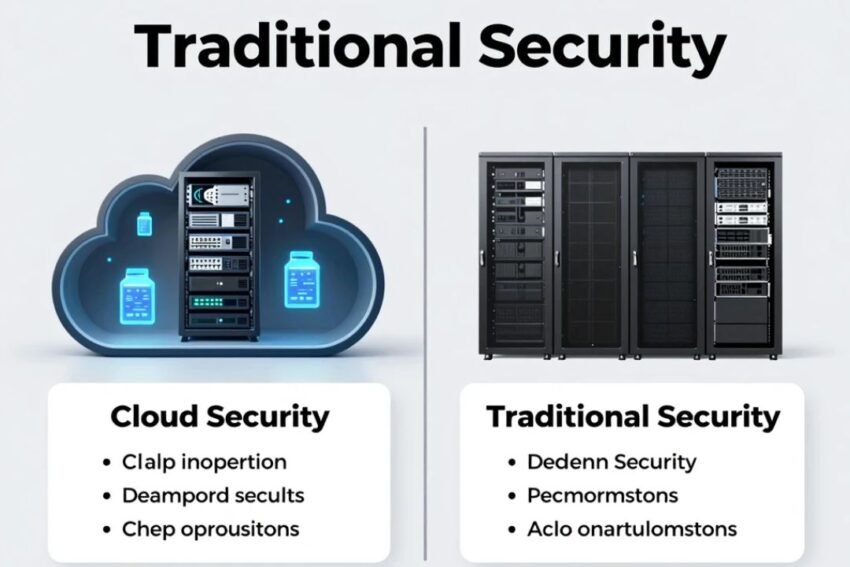
Cloud Security vs Traditional Security: Key Difference
The biggest difference is where infrastructure and resources are located and how they are accessed.
Traditional security often protects systems inside a controlled physical environment.
Cloud security protects resources that may exist across cloud platforms and can be accessed through the internet, APIs, applications, and distributed networks.
This changes how organizations approach identity, monitoring, infrastructure management, and security responsibility.
Cloud Security vs Traditional Security Comparison
| Feature | Cloud Security | Traditional Security |
|---|---|---|
| Infrastructure | Cloud-based or distributed | Primarily on-premises |
| Physical Control | Limited physical control | Greater physical control |
| Scaling | Highly flexible | Usually requires hardware |
| Access | Distributed and remote | Often network-centered |
| Security Management | More automated | Often more infrastructure-focused |
| Identity | Central security component | Important but traditionally network-oriented |
| Updates | Frequently automated | Often manually managed |
| Monitoring | Continuous cloud monitoring | Network and system monitoring |
| Responsibility | Shared with provider | Mostly organization-managed |
| Deployment | Rapid | Generally slower |
| Architecture | Dynamic | More static |
How Cloud Security Works
Cloud security uses several layers of protection.
Identity and Access Management
IAM controls who can access cloud resources.
Organizations can use:
- Multi-factor authentication
- Role-based access control
- Single sign-on
- Privileged access management
- Least-privilege permissions
Identity becomes especially important in cloud environments because users can connect from many locations.
Data Protection
Cloud data can be protected through encryption, access controls, classification, backups, and monitoring.
Network Security
Cloud networks can use firewalls, segmentation, secure gateways, and traffic monitoring.
Application Security
Cloud applications should be tested for vulnerabilities and protected against common attacks.
Continuous Monitoring
Security teams can monitor cloud activity for unusual logins, configuration changes, API activity, and suspicious data transfers.
How Traditional Security Works
Traditional security often uses a layered network defense model.
A typical environment may include:
- Physical security.
- Network firewall.
- Internal network segmentation.
- Endpoint protection.
- Authentication.
- Application security.
- Data backups.
- Security monitoring.
Organizations traditionally had direct control over servers and network hardware.
Security teams could physically inspect equipment, control network access, and manage infrastructure directly.
Benefits of Cloud Security
Cloud security offers several potential advantages.
Scalability
Cloud resources can scale as business requirements change.
Security controls can also be integrated into dynamic environments.
Centralized Visibility
Cloud security platforms can provide visibility across large numbers of cloud resources.
Automation
Security monitoring, configuration checks, and threat detection can be automated.
Remote Access Protection
Cloud security can support distributed employees and remote access through identity-based controls.
Faster Deployment
Cloud security controls can often be deployed alongside cloud infrastructure.
Advanced Security Services
Cloud providers and security vendors offer technologies for identity, monitoring, encryption, workload protection, and compliance.
Benefits of Traditional Security
Traditional security also has advantages.
Physical Control
Organizations can directly control physical infrastructure.
Predictable Infrastructure
On-premises environments can sometimes be easier to understand when infrastructure changes slowly.
Customization
Businesses may have greater control over hardware and network architecture.
Local Data Management
Some organizations prefer keeping sensitive information within controlled facilities.
Existing Investment
Companies with significant on-premises infrastructure may already have security tools and expertise designed for traditional environments.
Cloud Security Risks
Cloud environments introduce several security risks.
Misconfiguration
Incorrect cloud settings can accidentally expose data or services.
Stolen Credentials
Compromised passwords, access keys, and tokens can provide attackers with access.
Insecure APIs
Poorly protected APIs can expose applications and data.
Excessive Permissions
Users with unnecessary privileges can create larger security risks.
Multi-Cloud Complexity
Managing multiple cloud providers can make security policies more difficult to maintain.
Third-Party Risk
Cloud applications and integrations can introduce additional dependencies.
Traditional Security Risks
Traditional environments also have significant risks.
Physical Attacks
Servers and networking equipment can be physically damaged or stolen.
Hardware Failure
A failed server or storage device can interrupt operations.
Manual Configuration
Manually managed systems can be vulnerable to configuration errors.
Limited Scalability
Expanding physical infrastructure requires additional hardware.
Remote Access Risks
Traditional systems may require VPNs and other technologies to support remote workers.
Shared Responsibility Model
One of the most important differences between cloud and traditional security is the shared responsibility model.
In cloud environments, the cloud provider typically protects certain aspects of the underlying infrastructure.
The customer remains responsible for other areas, such as:
- Data
- User accounts
- Permissions
- Applications
- Configurations
The exact responsibilities depend on the cloud service model.
In traditional infrastructure, organizations generally manage a larger portion of the physical and technical security stack themselves.
Understanding responsibility boundaries is essential when moving workloads to the cloud.
Cloud Security and Zero Trust
Cloud environments have increased the importance of Zero Trust security.
Zero Trust assumes that access should be continuously verified rather than automatically trusted based on network location.
Important Zero Trust principles include:
- Verify identities
- Use least privilege
- Monitor activity
- Secure devices
- Segment resources
- Continuously evaluate access
This model works well with cloud environments where users and applications may operate from different locations.
Identity: The New Security Perimeter
Traditional security often placed significant emphasis on the network perimeter.
Cloud environments make identity increasingly important.
A user may access cloud applications from a home computer, mobile device, office network, or another location.
As a result, organizations increasingly use:
- MFA
- Passwordless authentication
- IAM
- Conditional access
- Privileged access management
- Identity monitoring
Protecting identities can help reduce unauthorized access.
Cloud Security and Traditional Firewalls
Firewalls remain important in both environments, but cloud environments often use additional security controls.
Cloud networks can use:
- Virtual firewalls
- Security groups
- Network access controls
- Web application firewalls
- API gateways
- Micro-segmentation
These controls can protect cloud workloads and applications without depending entirely on a physical network perimeter.
Data Security Differences
Data security is important in both models.
Traditional environments may use physical storage systems, internal databases, and on-premises backup infrastructure.
Cloud environments may distribute information across:
- Cloud databases
- Object storage
- SaaS platforms
- Applications
- APIs
- Multiple geographic regions
Organizations therefore need clear data classification, encryption, access control, retention, and monitoring policies.
Cloud Security and Application Development
Cloud computing has encouraged faster application development.
Developers can quickly create:
- APIs
- Containers
- Serverless applications
- Microservices
- Databases
- Cloud infrastructure
This creates a need for integrated security.
DevSecOps can bring security controls into development and deployment workflows.
Security testing may include:
- Code scanning
- Dependency analysis
- Container scanning
- Secret detection
- Infrastructure-as-code scanning
- Vulnerability testing
Cloud Security Tools vs Traditional Security Tools
Traditional security environments may depend heavily on:
- Hardware firewalls
- Antivirus
- Intrusion detection
- VPNs
- Network monitoring
- Physical security
Cloud environments can use:
- CSPM
- CNAPP
- Cloud workload protection
- IAM
- CASB
- API security
- Cloud data security
- SIEM
- XDR
- Zero Trust platforms
Modern organizations often combine technologies from both categories.
Hybrid Security
Many businesses do not operate entirely in the cloud or entirely on premises.
Instead, they use hybrid environments.
A hybrid infrastructure may include:
- On-premises servers
- Public cloud services
- Private cloud
- SaaS applications
- Remote employees
- Cloud databases
Hybrid security requires consistent identity, access, monitoring, and data protection across environments.
Which Security Model Is More Suitable?
The appropriate security approach depends on the organization’s requirements.
Cloud security may be useful for businesses that need:
- Rapid scalability
- Remote access
- Cloud applications
- Flexible infrastructure
- Automated security
- Distributed operations
Traditional security may remain important for organizations that require:
- Physical infrastructure control
- Specialized hardware
- Legacy applications
- Specific operational requirements
Many organizations use a combination of both.
Cloud Security Best Practices
Businesses moving to the cloud should follow several best practices.
Enable MFA
Protect important accounts with multi-factor authentication.
Use Least Privilege
Give users and applications only the permissions they require.
Encrypt Sensitive Data
Protect important information during storage and transmission.
Monitor Cloud Activity
Track logins, configuration changes, API activity, and unusual behavior.
Secure APIs
Use strong authentication, authorization, validation, and rate limiting.
Protect Backups
Maintain secure and tested backups.
Review Configurations
Regularly check cloud resources for security weaknesses.
Train Employees
Teach users how to recognize phishing, credential theft, and other security threats.
Cloud Security Best Practices for Traditional Infrastructure
Organizations maintaining on-premises infrastructure should also:
- Keep systems updated.
- Protect administrator accounts.
- Segment networks.
- Use strong authentication.
- Monitor endpoints.
- Maintain backups.
- Encrypt sensitive information.
- Restrict physical access.
- Test disaster recovery.
- Monitor network traffic.
Security principles remain important regardless of where infrastructure is located.
The Future of Cloud and Traditional Security
The distinction between cloud security and traditional security is becoming less rigid.
Organizations increasingly use security architectures that protect users, applications, data, and devices regardless of location.
Future security environments may increasingly use:
- AI-powered threat detection
- Zero Trust
- Automated response
- Identity-based security
- Cloud-native protection
- AI-agent security
- Continuous monitoring
- Advanced API protection
- Automated compliance
Artificial intelligence can help analyze large amounts of security data and identify unusual activity.
At the same time, human oversight remains important for high-impact security decisions.
Common Mistakes During Cloud Migration
Businesses can create security problems when moving from traditional infrastructure to the cloud.
Common mistakes include:
Assuming Cloud Means Automatic Security
Cloud providers protect certain infrastructure components, but customers still have security responsibilities.
Copying Old Security Models
Traditional network-based security models may not be sufficient for dynamic cloud environments.
Ignoring Identity
Cloud security depends heavily on account and permission management.
Poor Configuration Management
Incorrect settings can expose cloud resources.
Forgetting APIs
Modern applications rely heavily on APIs that require strong protection.
Cloud Security vs Traditional Security: Final Comparison
Cloud security and traditional security are not completely separate concepts.
Both rely on fundamental principles such as:
- Authentication
- Authorization
- Encryption
- Monitoring
- Vulnerability management
- Backup
- Incident response
The major difference is the environment in which those principles are implemented.
Cloud security must account for dynamic infrastructure, distributed identities, APIs, automation, and shared responsibility.
Traditional security focuses more heavily on physical infrastructure, controlled networks, hardware, and organization-managed systems.
Conclusion
Cloud security vs traditional security is an important topic for organizations deciding how to protect modern infrastructure.
Traditional security provides strong controls for on-premises environments, physical infrastructure, internal networks, and legacy systems. Cloud security extends cybersecurity practices into dynamic cloud environments where applications, data, identities, and workloads may be distributed across multiple platforms.
Cloud environments require greater emphasis on identity security, automation, continuous monitoring, API protection, configuration management, Zero Trust, and shared responsibility.
Traditional security remains relevant, particularly for organizations with on-premises infrastructure and specialized systems.
For many businesses, the most practical approach is not choosing one model exclusively. A hybrid security strategy can combine cloud-native controls with established traditional security technologies.
As organizations continue adopting cloud computing, AI, remote work, and distributed applications, cybersecurity will increasingly focus on protecting users, identities, applications, workloads, and data wherever they operate.
The goal is to build a security architecture that is scalable, continuously monitored, properly configured, and capable of responding to changing threats.
Ultimately, effective security depends less on whether infrastructure is cloud-based or traditional and more on how well an organization implements strong access controls, data protection, monitoring, vulnerability management, security automation, backups, and ongoing risk management.