Introduction
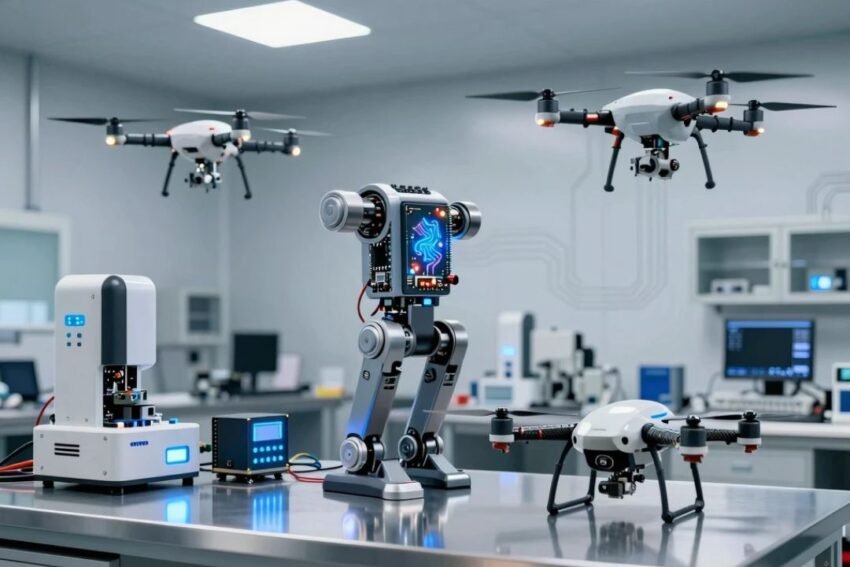
The future of robotics and drones is becoming increasingly connected to artificial intelligence, automation, advanced sensors, computer vision, robotics software, and next-generation wireless technology. Machines that once required constant human control are gradually becoming capable of understanding their environments, processing information, navigating spaces, and performing increasingly complex tasks.
Robots are already used in manufacturing, warehouses, healthcare, agriculture, homes, and research. Drones are used for photography, mapping, surveying, agriculture, inspections, construction, and emergency response. As technology advances, these machines are expected to become more autonomous, intelligent, efficient, and adaptable.
Artificial intelligence is particularly important because it allows machines to process large amounts of information and respond to changing conditions. Combined with better hardware, batteries, sensors, connectivity, and software, AI could significantly expand the capabilities of robots and drones.
However, the future will also bring challenges involving cybersecurity, safety, privacy, regulation, cost, employment, and responsible use.
This guide explores the future of robotics and drones, including AI-powered machines, autonomous systems, humanoid robots, smart drones, collaborative robots, industrial automation, robotics in everyday life, and next-generation opportunities.
What Is the Future of Robotics and Drones?
The future of robotics and drones is centered around increasing levels of automation and autonomy.
Traditional machines generally follow fixed instructions or require direct human control. Future systems are expected to use AI, sensors, computer vision, and advanced software to make more decisions based on their surroundings.
Future robots and drones may be able to:
- Understand their environments
- Recognize objects
- Plan tasks
- Avoid obstacles
- Communicate with other machines
- Learn from data
- Operate with limited human intervention
This does not necessarily mean that humans will disappear from the workflow. In many applications, human supervision will remain important.
1. AI-Powered Robotics
Artificial intelligence will remain one of the most important technologies shaping robotics.
AI can help robots understand information from cameras and sensors and make decisions based on that information.
Potential capabilities include:
- Object recognition
- Visual inspection
- Navigation
- Motion planning
- Predictive maintenance
- Task optimization
- Human interaction
Traditional automation is usually designed for predictable environments. AI-powered robotics can potentially handle more variation.
For example, a warehouse robot could use computer vision to recognize different packages instead of relying only on fixed positions.
2. Autonomous Robots
Autonomous robots are designed to perform tasks with limited direct human control.
They can use sensors and AI to understand their surroundings.
Examples include:
- Autonomous mobile robots
- Warehouse robots
- Delivery robots
- Cleaning robots
- Agricultural robots
Future autonomous systems may become better at adapting to changing environments.
However, autonomous operation requires reliable sensors, software, safety systems, and human oversight.
3. Humanoid Robots
Humanoid robots are expected to remain an important area of robotics development.
These machines are designed around human-like physical structures.
They may include:
- Arms
- Hands
- Legs
- Cameras
- Sensors
- AI systems
The potential advantage is that humanoid robots could operate in environments already designed for humans.
Potential applications include manufacturing, warehouses, hospitality, research, education, and selected service tasks.
The technology still faces challenges involving balance, manipulation, energy consumption, reliability, cost, and safety.
4. More Advanced Collaborative Robots
Collaborative robots are designed to work alongside humans.
Future cobots may become more intelligent and flexible.
They could potentially recognize:
- Human movements
- Objects
- Workplace hazards
- Changing task requirements
AI may allow cobots to adjust workflows without requiring complete reprogramming for every small change.
This could make robotics more accessible to businesses that need flexible automation.
5. Autonomous Drones
The future of drone technology is also moving toward greater autonomy.
Autonomous drones can use:
- GPS
- Cameras
- LiDAR
- Radar
- AI
- Navigation software
to support automated flight.
Future drones may be able to plan routes, avoid obstacles, monitor environments, and complete predefined missions with less direct human control.
Applications may include:
- Agriculture
- Mapping
- Inspection
- Emergency response
- Infrastructure monitoring
- Environmental observation
6. AI-Powered Drone Inspection
Drone inspection is likely to become more intelligent as AI image analysis improves.
A drone can collect large numbers of photographs or video frames from infrastructure.
AI systems can potentially analyze these images to identify:
- Cracks
- Corrosion
- Damaged components
- Surface abnormalities
- Maintenance issues
Human experts can then review important findings.
This combination of autonomous data collection and AI analysis could make infrastructure inspection more efficient.
7. Smart Agriculture Robotics
Agriculture is another area where robotics and drones may work together.
Drones can monitor fields from above, while ground robots can operate closer to crops.
Together they could support:
- Crop monitoring
- Field mapping
- Weed detection
- Plant health analysis
- Soil observation
- Targeted agricultural operations
AI could analyze information collected by different machines and help farmers identify areas requiring attention.
8. Robotics in Smart Factories
Future factories are likely to combine robotics with AI, sensors, cloud computing, and industrial IoT.
Smart factories can connect machines and production systems so that information flows between different parts of the operation.
Robots may perform:
- Assembly
- Packaging
- Inspection
- Material handling
- Quality control
AI can analyze production information and potentially identify inefficiencies.
Digital twins may also allow manufacturers to simulate changes before implementing them in physical factories.
9. Autonomous Warehouse Systems
Warehouses are likely to become increasingly automated.
Future warehouse systems may combine:
- Autonomous mobile robots
- Robotic arms
- Computer vision
- AI
- Automated storage
- Intelligent software
Robots could transport products while robotic arms perform picking and sorting.
AI could coordinate multiple machines and optimize warehouse workflows.
Human employees may continue to handle tasks that require complex judgment, maintenance, management, and customer-related activities.
10. Drone Delivery Technology
Drone delivery is another potential area of growth.
Drones could potentially transport:
- Small packages
- Food
- Medical supplies
- Emergency equipment
Autonomous navigation may allow drones to operate along approved routes with limited direct control.
However, widespread drone delivery requires careful management of airspace, safety, weather, battery capacity, package handling, and applicable regulations.
11. Better Batteries and Energy Systems
Battery technology is critical to the future of mobile robots and drones.
For drones, battery limitations directly affect flight time and payload.
For mobile robots, energy efficiency influences how long machines can operate before charging.
Future improvements may involve:
- Higher energy density
- Faster charging
- Better battery management
- More efficient motors
- Lightweight materials
Better energy systems could make autonomous machines more practical for longer operations.
12. Edge AI for Autonomous Machines
Edge AI allows AI processing to occur directly on a device or near the machine.
This can be useful for robots and drones because many decisions need to happen quickly.
Benefits can include:
- Lower latency
- Faster responses
- Reduced cloud dependence
- Improved real-time processing
For example, if a drone detects an obstacle, processing the information locally can allow the system to react more quickly.
13. 5G and Future Connectivity
Advanced wireless connectivity can help robots and drones communicate with other systems.
Potential applications include:
- Smart factories
- Remote monitoring
- Connected warehouses
- Drone operations
- Autonomous vehicles
- Industrial IoT
5G can provide high-speed connectivity and low latency in suitable environments.
Future wireless technologies may provide additional capabilities for connected autonomous machines.
14. Swarm Robotics and Drone Fleets
Instead of controlling one machine, future systems may coordinate groups of robots or drones.
This approach is often called swarm robotics when multiple machines work together.
Potential applications include:
- Large-area monitoring
- Search operations
- Environmental research
- Agriculture
- Mapping
A group of machines can divide a large task into smaller activities.
However, coordinating multiple autonomous machines creates additional challenges involving communication, control, collision avoidance, and system reliability.
15. Robots and Drones Working Together
The future may involve integrated robotic ecosystems.
For example, drones could survey a construction site from above while ground robots inspect specific areas.
In agriculture, drones could identify crop problems while ground robots perform targeted tasks.
In warehouses, drones could monitor inventory while mobile robots transport products.
Combining different machines can allow each platform to perform the task it is best suited for.
16. Robotics-as-a-Service
Robotics-as-a-Service could make advanced automation more accessible.
Instead of purchasing expensive equipment, businesses may access robotic systems through service-based models.
Potential benefits include:
- Lower initial investment
- Easier technology testing
- Managed maintenance
- Flexible scaling
RaaS could be particularly useful for smaller companies that want automation without building a large robotics department.
17. Robotics in Healthcare
Healthcare robotics may continue to expand.
Potential applications include:
- Surgical assistance
- Rehabilitation
- Hospital logistics
- Laboratory automation
- Patient support
- Medical training
AI may improve the ability of robots to interpret information and assist healthcare professionals.
However, medical robotics requires strict safety standards and appropriate human supervision.
18. Home Robotics
Robots may become more common in everyday households.
Current examples include robotic vacuum cleaners and lawn-maintenance machines.
Future home robots could potentially assist with:
- Cleaning
- Monitoring
- Household organization
- Basic assistance
Natural-language AI could also make interactions with home robots more intuitive.
Privacy and cybersecurity will become increasingly important because household robots may process information from cameras, microphones, and other sensors.
19. Robotics and Drone Cybersecurity
As machines become connected and autonomous, cybersecurity will become more important.
Potential threats include:
- Unauthorized control
- Malware
- Credential theft
- Data interception
- Software vulnerabilities
- Communication attacks
Future robotic systems will need strong security measures such as:
- Secure authentication
- Encrypted communication
- Software updates
- Access controls
- Network monitoring
- Device protection
Security should be designed into autonomous systems rather than added later.
20. Digital Twins and Simulation
Digital twins can provide virtual representations of physical robots, drones, factories, and other systems.
Organizations can use simulations to:
- Test robotic workflows
- Train machines
- Predict maintenance
- Analyze performance
- Design factory layouts
This can reduce the need to test every scenario directly on expensive physical equipment.
Benefits of Future Robotics and Drone Technology
The development of autonomous machines can provide several potential benefits.
Increased Productivity
Robots can automate repetitive operations.
Improved Safety
Machines can perform some tasks in hazardous environments.
Faster Data Collection
Drones can collect information over large areas quickly.
Greater Precision
Robotic systems can perform repetitive tasks consistently.
Reduced Manual Work
Automation can reduce certain physically repetitive activities.
New Services
Autonomous machines can enable new logistics, inspection, agriculture, and monitoring services.
Improved Decision Support
AI systems can analyze data collected by robots and drones.
Challenges Facing the Future of Robotics and Drones
The technology also has significant challenges.
Safety
Autonomous machines must operate safely around people and infrastructure.
Cybersecurity
Connected machines can create new digital vulnerabilities.
Privacy
Cameras, sensors, and microphones can collect sensitive information.
Cost
Advanced robots and drones can remain expensive to develop and maintain.
Regulation
Autonomous drones and specialized robotic systems may require compliance with different laws and standards.
Battery Technology
Energy limitations can restrict operating time.
Workforce Changes
Automation can change job responsibilities and increase demand for technical skills.
Skills Needed for the Robotics and Drone Industry
The growth of robotics and drones is creating demand for specialized knowledge.
Useful skills include:
- Programming
- Robotics engineering
- Electronics
- Artificial intelligence
- Machine learning
- Computer vision
- Mechanical engineering
- Drone operation
- Navigation systems
- Cybersecurity
- Data analysis
Students and professionals can build careers by combining technical knowledge with practical robotics or drone projects.
How Businesses Can Prepare for the Future
Businesses interested in robotics and drones should adopt a practical approach.
Identify the Problem
Determine which tasks are repetitive, expensive, dangerous, or time-consuming.
Evaluate Technology
Compare available robotic and drone solutions.
Start Small
Test the technology through a limited pilot project.
Measure Results
Track productivity, accuracy, cost, safety, and operational improvements.
Train Employees
Employees should understand how to work with and supervise automated systems.
Protect Systems
Implement appropriate cybersecurity and access controls.
Scale Gradually
Expand automation after successful testing.
The Future of Human-Robot Collaboration
The future of robotics is not necessarily about replacing every human task.
Instead, many workplaces may involve human-robot collaboration.
Humans can provide:
- Creativity
- Judgment
- Communication
- Leadership
- Problem-solving
Robots can provide:
- Repetitive work
- Precision
- Physical strength
- Continuous operation
- Data collection
Combining these capabilities can create new forms of work.
The Role of AI in Next-Generation Robotics
AI will likely remain the central technology connecting many future robotics developments.
Generative AI may help machines understand natural-language instructions, while computer vision can help them interpret physical environments.
AI agents could potentially coordinate multiple digital and physical actions.
For example, a future system might receive a high-level task, break it into smaller steps, assign actions to robots and drones, monitor results, and request human approval when a decision requires additional oversight.
This remains an evolving area, but the combination of AI and robotics could create increasingly sophisticated automation systems.
Future Opportunities in Robotics and Drones
Several industries may experience continued growth in robotics and drone applications.
Potential areas include:
- Smart manufacturing
- Agriculture
- Healthcare
- Logistics
- Construction
- Energy
- Infrastructure inspection
- Environmental monitoring
- Retail
- Home automation
- Emergency response
- Scientific research
As hardware becomes more capable and software becomes more intelligent, new applications may emerge that are difficult to predict today.
Conclusion
The future of robotics and drones is closely connected to artificial intelligence, autonomous systems, advanced sensors, computer vision, edge computing, connectivity, and better energy technologies.
Robots are becoming more flexible and intelligent, while drones are moving toward greater autonomy and more advanced data-collection capabilities. Humanoid robots, collaborative robots, autonomous mobile robots, smart agricultural systems, warehouse automation, inspection drones, and connected robotic ecosystems could all play important roles in the coming years.
AI is likely to be one of the most important technologies driving this transformation. It can help machines understand environments, recognize objects, analyze information, plan tasks, and make decisions.
At the same time, technology companies and businesses will need to address safety, cybersecurity, privacy, regulation, cost, battery limitations, and workforce changes.
The most successful applications will likely focus on solving practical problems rather than automation for its own sake.
Robotics and drones are moving toward a future where intelligent machines can work alongside humans, collect and analyze information, automate physical tasks, and operate with increasing levels of autonomy. As AI and robotics technology continue to develop, these systems could become an essential part of modern industry, business, agriculture, healthcare, logistics, and everyday life.