Introduction
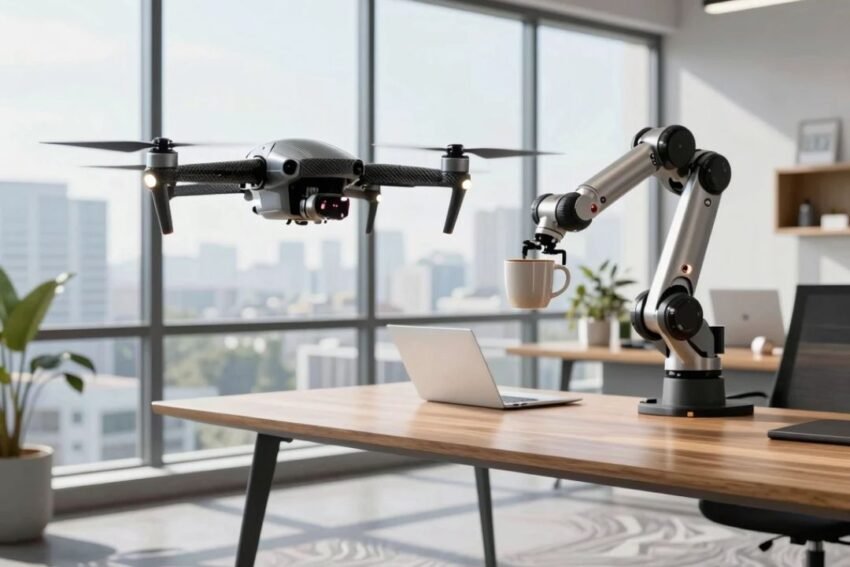
Robotics and drones technologies in 2026 are becoming increasingly important for businesses, industries, researchers, and everyday consumers. Advances in artificial intelligence, computer vision, sensors, automation, connectivity, batteries, and robotics software are helping machines perform more tasks with greater accuracy and less direct human control.
Robots are being used in factories, warehouses, hospitals, agriculture, retail, homes, and research environments. Drones are also expanding beyond photography and entertainment into agriculture, surveying, construction, inspection, logistics, emergency response, and infrastructure monitoring.
The best robotics and drone technologies are not limited to a single type of machine. They include industrial robots, collaborative robots, autonomous mobile robots, humanoid robots, agricultural drones, inspection drones, mapping systems, AI-powered navigation, computer vision, and connected robotic platforms.
Businesses can use these technologies to automate repetitive tasks, improve workplace safety, increase productivity, and collect valuable information. Consumers can benefit from robotic cleaning devices, smart home machines, camera drones, and other automated products.
This guide explores the best robotics and drones technologies in 2026, their applications, benefits, challenges, and future potential.
What Are Robotics and Drone Technologies?
Robotics technology focuses on machines that can sense, process information, move, and perform physical tasks.
A robotic system can include:
- Motors
- Sensors
- Cameras
- Processors
- Controllers
- Software
- Artificial intelligence
- Communication systems
Drones are unmanned aircraft that can be remotely controlled or operate with different levels of autonomy.
A modern drone may contain:
- Flight controllers
- GPS
- Cameras
- Obstacle sensors
- Batteries
- Wireless communication
- Navigation software
- AI-based processing
Both robotics and drones increasingly rely on AI and automation.
1. AI-Powered Robots
Artificial intelligence is one of the most important technologies behind modern robotics.
Traditional robots usually perform predefined instructions. AI-powered robots can process information from their surroundings and adapt to changing situations.
AI can help robots:
- Recognize objects
- Understand environments
- Navigate spaces
- Predict equipment problems
- Optimize movements
- Identify patterns
- Assist with decision-making
AI-powered robotics is particularly useful when robots need to operate in environments that are not perfectly predictable.
For businesses, this can create more flexible automation systems.
2. Autonomous Mobile Robots
Autonomous mobile robots, or AMRs, can move through environments without requiring continuous manual control.
They commonly use:
- Cameras
- LiDAR
- Sensors
- Mapping software
- Artificial intelligence
- Navigation algorithms
AMRs are widely suited to environments such as warehouses and factories.
They can transport:
- Packages
- Components
- Inventory
- Tools
- Supplies
By automating material movement, businesses can reduce repetitive transportation tasks and improve workflow efficiency.
3. Collaborative Robots
Collaborative robots, often known as cobots, are designed to work alongside humans.
They can support tasks such as:
- Assembly
- Packaging
- Inspection
- Machine operation
- Product handling
Cobots can be useful for businesses that need flexible automation.
Unlike some traditional industrial robots that operate inside restricted areas, collaborative robots can be designed with sensors and safety features that support closer interaction with workers.
Their usefulness depends on proper deployment, risk assessment, programming, and workplace safety procedures.
4. Humanoid Robotics
Humanoid robotics is another rapidly developing area.
Humanoid robots are designed with physical structures that resemble humans, often including two arms and two legs.
Potential applications include:
- Manufacturing
- Warehousing
- Research
- Hospitality
- Education
- Service environments
One potential advantage of humanoid robots is their ability to operate in environments already designed for people.
However, humanoid robotics remains technically challenging because robots need reliable balance, movement, object manipulation, perception, power management, and safety systems.
5. Industrial Robotic Arms
Industrial robotic arms remain important in modern manufacturing.
They can perform repetitive and precise operations such as:
- Welding
- Painting
- Assembly
- Packaging
- Cutting
- Material handling
Robotic arms can operate for extended periods and provide consistent movement.
When combined with machine vision and AI, they can potentially handle more flexible manufacturing tasks.
Industries such as automotive manufacturing, electronics, food processing, and packaging can benefit from robotic automation.
6. AI-Powered Drones
AI is also transforming drone technology.
Traditional drones require significant human control. AI-powered drones can use onboard sensors and software to support navigation and automated decision-making.
AI can help drones:
- Detect objects
- Avoid obstacles
- Track locations
- Analyze images
- Navigate routes
- Identify patterns
For example, a drone inspecting a large solar installation could capture thousands of images and use AI-assisted software to identify potential visual abnormalities.
7. Agricultural Drone Technology
Agricultural drones are increasingly useful in precision farming.
Farmers can use drones to collect aerial information about fields and crops.
Potential applications include:
- Crop monitoring
- Field mapping
- Plant health analysis
- Irrigation assessment
- Agricultural surveys
Drone imagery can provide a detailed overview of large agricultural areas.
AI-powered analysis can then help identify areas that may require additional attention.
This can support more targeted farming decisions and potentially reduce unnecessary use of resources.
8. Mapping and Surveying Drones
Mapping drones can capture aerial data for surveying and geographic analysis.
They are useful in:
- Construction
- Land surveying
- Mining
- Infrastructure planning
- Environmental monitoring
- Real estate
High-resolution cameras and specialized sensors can create detailed maps and three-dimensional models.
Drone surveying can also reduce the need for workers to spend extensive time in difficult terrain.
9. Industrial Inspection Drones
Industrial inspection is another major application.
Drones can inspect structures that may be difficult or dangerous for humans to access.
Potential targets include:
- Bridges
- Power infrastructure
- Communication towers
- Pipelines
- Wind turbines
- Solar panels
- Industrial facilities
Drones can collect images and video while keeping operators at a safer distance.
AI software can assist with analyzing the collected information and identifying potential maintenance issues.
10. Robotic Warehouse Technology
Warehouse automation is an important business application of robotics.
Modern warehouses can use robots for:
- Picking
- Sorting
- Transportation
- Inventory movement
- Package handling
Robotic systems can communicate with warehouse management software to coordinate operations.
Autonomous robots can also optimize routes and move products between workstations.
As online commerce continues to require efficient logistics, warehouse robotics can become an important part of modern supply chains.
11. Robotic Healthcare Systems
Healthcare organizations are exploring robotics for a range of applications.
Robots can support:
- Surgical procedures
- Rehabilitation
- Laboratory automation
- Hospital logistics
- Patient assistance
- Medical training
Robotic surgical systems can provide doctors with specialized tools and precise movement capabilities.
Other robots can transport supplies or assist with routine hospital operations.
Because healthcare involves human safety, robotic systems require appropriate testing, supervision, and regulatory compliance.
12. Consumer Home Robots
Robotics is no longer limited to factories.
Consumers can use robotic devices for everyday tasks.
Examples include:
- Robotic vacuum cleaners
- Robotic mowers
- Smart cleaning robots
- Home monitoring robots
These devices commonly use sensors and mapping systems to navigate their surroundings.
AI can help them recognize obstacles and optimize routes.
As hardware becomes more affordable, home robotics may become more common.
13. Drone Photography and Videography
Camera drones remain popular among consumers and professionals.
They can capture aerial footage for:
- Travel content
- Real estate
- Weddings
- Films
- Marketing
- Sports
- Social media
Modern camera drones can provide stabilized footage and automated flight features.
Users should always follow applicable aviation and privacy requirements when operating drones.
14. Search and Rescue Drones
Drones can be valuable during emergency situations.
They can quickly survey large areas and provide visual information to response teams.
Potential applications include:
- Search operations
- Disaster assessment
- Flood monitoring
- Fire observation
- Emergency mapping
Thermal cameras and other specialized sensors can make drones particularly useful in certain search environments.
15. Robotics and Drones for Construction
Construction companies can use robotics and drones to improve project monitoring.
Drones can help with:
- Site surveys
- Progress monitoring
- Mapping
- Inspections
- Documentation
Robots can potentially assist with:
- Material movement
- Bricklaying
- Repetitive construction tasks
- Inspection
- Autonomous equipment
Combining aerial data from drones with robotic automation can provide businesses with a more complete view of construction operations.
16. Edge Computing for Robotics and Drones
Edge computing allows data processing to happen closer to the device.
This can be important for robots and drones that need rapid responses.
Benefits can include:
- Lower latency
- Faster decision-making
- Reduced cloud dependency
- Better real-time processing
For example, a drone detecting an obstacle may need to respond immediately rather than waiting for remote cloud processing.
Edge AI can therefore improve certain autonomous applications.
17. Robotics, Drones and 5G
5G connectivity can support connected robotics and drone systems.
Potential applications include:
- Remote monitoring
- Smart factories
- Industrial automation
- Real-time drone data
- Connected autonomous systems
High-speed wireless networks can help machines communicate with cloud platforms and other devices.
However, performance depends on network coverage, hardware, latency, and the specific application.
18. Swarm Robotics and Drone Systems
Swarm technology involves multiple machines working together.
Instead of using one large machine, organizations can potentially deploy several smaller robots or drones.
Possible applications include:
- Large-area monitoring
- Mapping
- Environmental research
- Agriculture
- Search operations
Coordinated systems can divide tasks between machines.
However, swarm robotics also creates challenges involving communication, coordination, safety, and system management.
19. Robotics-as-a-Service
Robotics-as-a-Service (RaaS) is a business model that allows organizations to access robotic capabilities without necessarily purchasing and managing all hardware themselves.
This can be useful for businesses that want to experiment with automation.
Potential RaaS applications include:
- Warehouse robots
- Cleaning robots
- Security robots
- Manufacturing automation
- Logistics
Subscription or service-based models can make robotics more accessible to smaller businesses.
20. Digital Twins for Robotics
Digital twin technology creates a virtual representation of a physical system.
Businesses can use digital twins to simulate robotic environments before making physical changes.
Applications include:
- Robot training
- Workflow testing
- Maintenance planning
- Factory optimization
- Performance analysis
Digital twins can help organizations identify problems before implementing changes on expensive physical equipment.
Robotics and Drone Cybersecurity
As robots and drones become increasingly connected, cybersecurity becomes a major concern.
Potential threats include:
- Unauthorized control
- Data theft
- Malware
- Credential theft
- Communication attacks
- Software vulnerabilities
Organizations should use:
- Strong authentication
- Encrypted communications
- Secure software updates
- Access controls
- Network monitoring
- Regular security testing
Security should be integrated into robotics and drone systems from the beginning.
Benefits of Robotics and Drone Technologies
The best robotics and drones technologies can provide several potential benefits.
Higher Productivity
Machines can perform repetitive tasks consistently and efficiently.
Improved Safety
Robots and drones can operate in certain dangerous or difficult environments.
Better Accuracy
Automated systems can perform highly repetitive operations with consistent precision.
Faster Data Collection
Drones can quickly capture aerial information over large areas.
Reduced Repetitive Work
Automation can reduce some physically repetitive activities for human workers.
Operational Flexibility
Modern AI-powered systems can potentially adapt to changing conditions.
New Business Opportunities
Robotics and drones can create new services, products, and business models.
Challenges of Robotics and Drones
Despite their benefits, these technologies have limitations.
High Costs
Advanced robots, sensors, software, and drones can require significant investment.
Maintenance
Machines need hardware maintenance, software updates, and technical support.
Battery Limitations
Drones and mobile robots can be limited by battery capacity and charging infrastructure.
Cybersecurity
Connected machines can become targets for cyberattacks.
Privacy
Camera-equipped systems can collect sensitive information.
Regulation
Drone operations and some robotic applications must follow applicable laws and safety standards.
Technical Skills
Businesses may require employees with expertise in robotics, AI, programming, electronics, and cybersecurity.
How to Choose Robotics and Drone Technology
Businesses should evaluate technology based on their actual operational requirements.
Important questions include:
- What task needs to be automated?
- How often is the task performed?
- What level of accuracy is required?
- Can the technology operate safely?
- What software integrations are necessary?
- What maintenance is required?
- How much will implementation cost?
- What cybersecurity controls are available?
- What training will employees need?
- What measurable benefit will the technology provide?
Starting with a small pilot project can help businesses evaluate performance before expanding automation.
The Future of Robotics and Drones
The future of robotics and drones will likely be influenced heavily by AI.
Robots may become better at understanding environments, manipulating objects, and working alongside humans.
Drones may become more autonomous and capable of performing longer missions with limited intervention.
Other important developments could include:
- Better batteries
- More capable AI models
- Advanced sensors
- Improved computer vision
- Autonomous navigation
- Edge AI
- 5G and future wireless networks
- Swarm robotics
- Humanoid robots
- Smart factories
- Autonomous logistics
The combination of these technologies could create highly automated systems across multiple industries.
Robotics and Drones for Everyday Life
Consumers may increasingly interact with robotic technology without thinking of it as advanced robotics.
Smart cleaning devices, automated lawn equipment, camera drones, warehouse delivery systems, and intelligent home devices are examples of how automation can become part of everyday routines.
Future consumer robots may offer more natural interaction through voice, vision, and AI.
However, convenience must be balanced with privacy, security, reliability, and user control.
Conclusion
The best robotics and drones technologies in 2026 cover a wide range of applications, from industrial robotic arms and collaborative robots to autonomous mobile robots, humanoid systems, AI-powered drones, agricultural drones, mapping platforms, inspection systems, and consumer robotics.
Artificial intelligence is playing a major role in this transformation. AI can help machines understand their surroundings, analyze information, navigate environments, and automate increasingly complex tasks.
Businesses can benefit from robotics and drones through improved productivity, greater precision, faster data collection, workplace safety, and reduced repetitive workloads. Consumers can also benefit from increasingly intelligent home robots and drone technologies.
At the same time, successful adoption requires attention to cost, cybersecurity, privacy, battery life, maintenance, regulation, safety, and technical skills.
The future will likely bring closer integration between robotics, drones, AI, edge computing, 5G, IoT, and cloud platforms.
Robotics and drones are becoming powerful technologies for both business and everyday life. As intelligent automation continues to improve, these machines could play an increasingly important role in how people work, produce goods, collect information, deliver services, and interact with technology.